
Open-plan distraction
Nearby conversations pull people out of focused work and create repeated interruptions throughout the day.
Sound Masking
AET designs and installs sound masking solutions that make conversations less intelligible at a distance—improving speech privacy, reducing distraction and helping employees focus.
With 20+ years’ experience, every system is designed and calibrated around your office so it works quietly in the background without becoming another distraction.
20+ years’ experience • UK-manufactured systems • Projects from single rooms to full floors
Why it matters
The issue is not always volume. In many offices, the problem is speech clarity. When conversations remain easy to understand across the room, focus, privacy and comfort all suffer.
Nearby conversations pull people out of focused work and create repeated interruptions throughout the day.
Confidential discussions can be understood beyond the people they were meant for.
Sound masking can support changing office layouts where partitions, ceilings and furniture alone do not solve the issue.
The aim is a balanced background sound that feels natural, not a workplace that feels dead or over-treated.
How AET helps
AET reviews the workplace layout, ceiling conditions, occupancy patterns, privacy requirements and likely sound paths before specifying the system.
Speakers are installed and calibrated in zones, so the background sound is even, controlled and unobtrusive. The aim is to reduce speech clarity at distance while preserving a comfortable working environment.
AET can supply direct or indirect sound masking. Where ceiling conditions suit it, we generally favour indirect systems to help achieve even coverage with fewer dead spots. The choice follows the needs of your building.
We recommend straightforward controls that help preserve the commissioned settings and discourage unnecessary adjustment. Wi-Fi and Bluetooth connectivity can be provided where required; these are options, rather than a requirement for every installation.
See this approach in our DLA Piper sound masking case study and SharkNinja office and meeting room project.
For a London example, explore our General Medical Council sound masking project in London and Manchester, covering meeting rooms and open-plan workspaces.
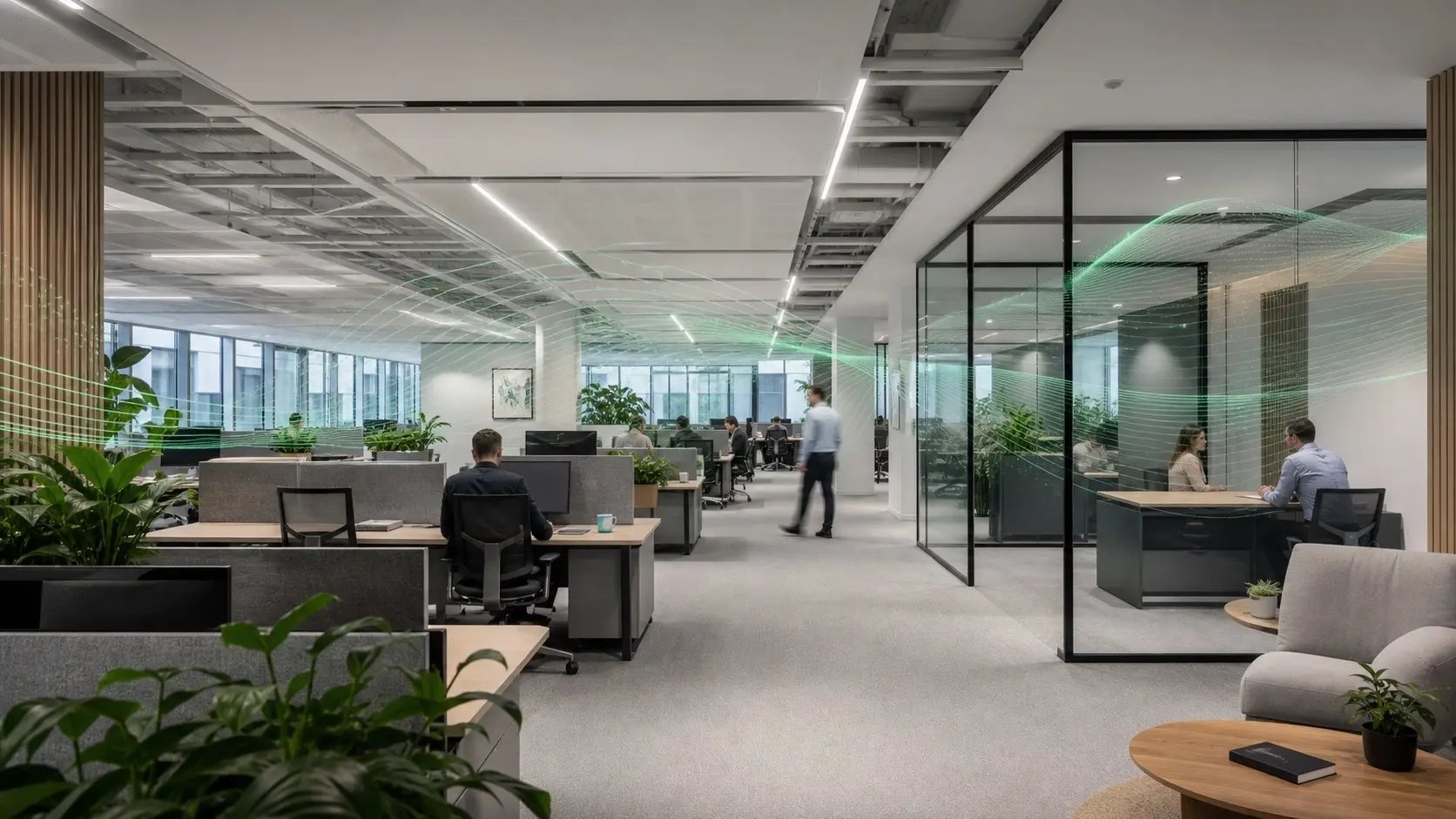
Built for real workplaces
AET combines specialist acoustic design, UK-manufactured equipment and practical installation support for sound masking projects across London and the UK, from individual rooms to major office installations.
Common applications
Sound Masking is most useful where speech carries further than it should, or where privacy, focus and comfort are affected by conversations in the surrounding space.
Reduce the area where speech remains intelligible across desks and shared work areas.
Support confidential conversations where glass, partitions or flanking paths allow speech to escape.
Improve privacy in patient-facing and counselling environments where confidentiality matters.
Where appropriate, sound masking infrastructure can support additional audio functions such as announcements.
Practical answers for teams considering sound masking in an office, meeting room or shared workplace.
Sound masking is a carefully controlled background sound that makes speech less intelligible at distance. It does not cancel noise; it reduces how clearly conversations stand out.
A correctly commissioned system should sit naturally in the background. AET calibrates systems so they support comfort and privacy without becoming a distraction themselves.
It is often best considered during fit-out, but it can also be installed retrospectively. AET can advise on the most practical route for live offices, refurbishments and new spaces.
Yes. Sound masking, acoustic panels, door seals and layout changes often work together. The right mix depends on the room, construction and privacy goal.
Talk to a specialist
Tell AET about the workplace, privacy issue or distraction problem you want to solve, including whether the project is for an existing office, refurbishment or new fit-out.
A specialist will review your enquiry and help identify the most practical next step.